
The elements that matter most under the ESRS for chemical companies
The chemical sector plays a massive role in supporting our modern world. Chemicals are essential inputs in the production of almost every product we consume.
The chemical sector covers a wide range of businesses, from producers of bulk and commodity chemicals to specialty and performance products, as well as distribution and supply-chain enablers. Together, these segments serve markets including agriculture, construction, consumer goods, and advanced industrial applications.
Chemical production is energy‑intensive, accounting for around 12% of global industrial energy use and about 2.5–3% of worldwide greenhouse gas emissions from primary chemicals alone. This is largely due to the fuel and feedstock needed to run high‑temperature processes and produce base chemicals such as ammonia, ethylene and methanol. Increasing energy efficiency, electrifying processes and switching to renewable inputs are therefore critical priorities for the sector. Chemical production also create serious social and health risks. Exposure to hazardous substances is linked to serious health issues, making working conditions and labour rights highly important topics in the sector.
These examples demonstrate the value of a strong grasp of material issues. Under the CSRD, double materiality assessments help companies clearly identify and communicate their most important impacts, risks and opportunities.
We reviewed 7 sustainability statements published by major European chemical companies in 2025 to identify the most commonly reported ESRS topics, gaps in coverage and notable practices.
Companies analysed include: AkzoNobel, BASF, Borealis, Brenntag, OCI Global, Syensqo and Yara.
Assessment Outcome
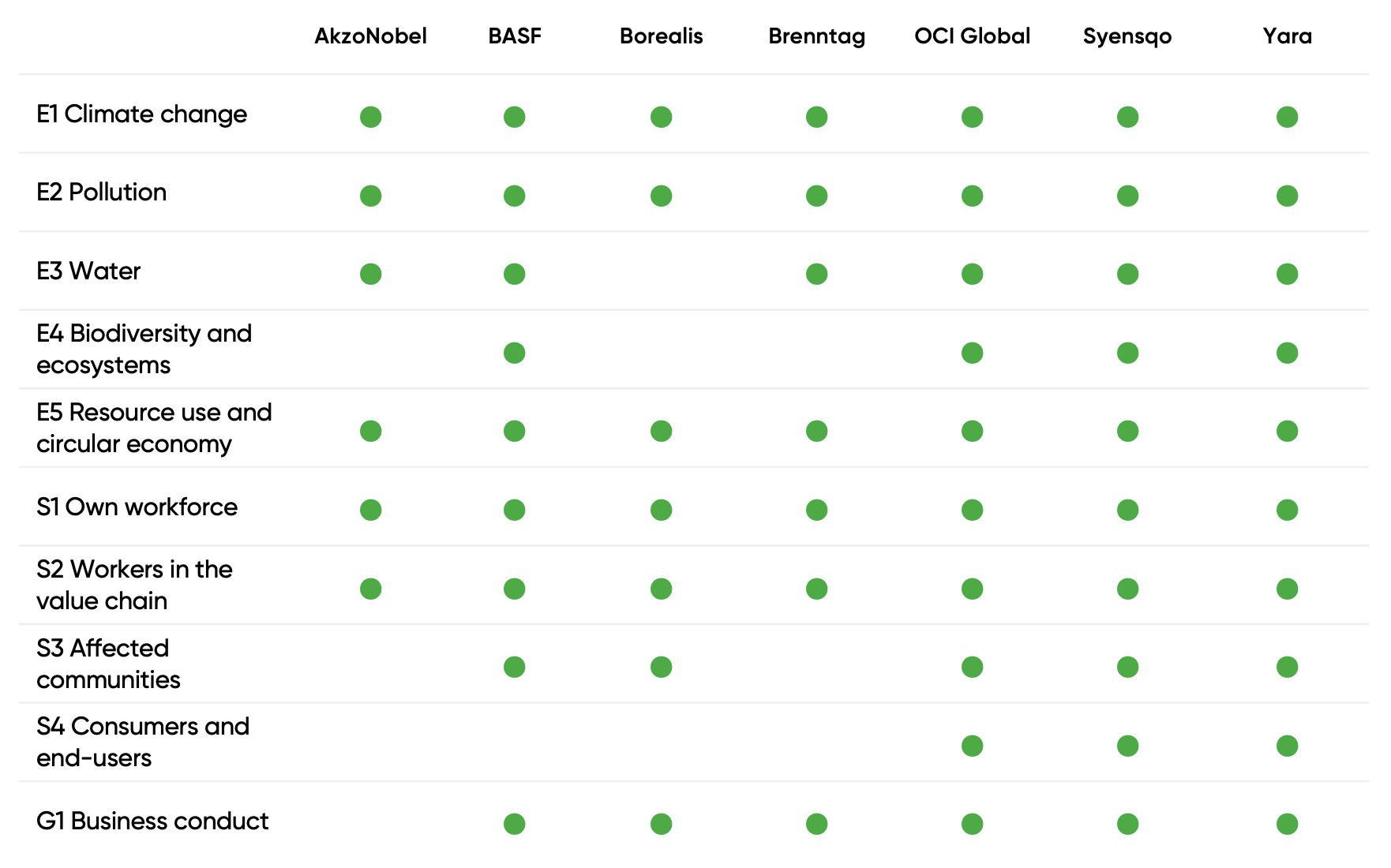
Three out of the seven companies identified all topics under the European Sustainability Reporting Standards (ESRS) as material: OCI Global, Syensqo and Yara.
A close look at the environmental topics
Across the environmental topics, all companies identified climate change, pollution, and resource use and the circular economy as material.
Companies that identified climate change as a material topic are mainly concerned about decarbonisation, energy efficiency, and both physical and transition risks related to climate change. Pollution was considered material due to the use of hazardous substances and the potential impact of spillages on the surrounding environment, including air and water. Resource use and the circular economy were considered material by all companies, given their high reliance on raw materials and the critical importance of properly managing and disposing of hazardous waste.
Almost all companies also considered water to be material, with only one exception, Borealis. While the company produces polyolefins and base chemicals, these processes rely on moderate cooling water rather than significant freshwater abstraction. Other companies producing nitrogen-based fertilisers such as OCI Group and Yara, require higher water amount due to the ammonia synthesis process, therefore identifying water as a material topic.
Biodiversity and ecosystems were deemed material by four companies. These companies depend on valuable natural resources while their business activities impact ecosystems through land use, pollution and agricultural value chains. Globally, the chemicals sector ranks third among industries for biodiversity impact after food products and oil and gas—primarily due to land conversion and nutrient pollution from chemical releases.
However, not all companies fully consider value chain impacts on biodiversity. For example, Syensqo identified land use change due to raw material cultivation, and BASF and Yara also flagged biodiversity loss from fertilisers and industrial chemicals as negative material impacts. In contrast, OCI Group only assesses biodiversity risks at its own production sites in stress areas.
Key social topics
All companies included in our analysis identify their own workforce and workers in the value chain as material topics. Within these areas, health and safety, working conditions, and training consistently emerge as the most material issues. This finding is expected, given employees’ high exposure to chemicals, making it important to have robust safety measures, adequate working conditions, and sufficient training to prevent accidents and mitigate adverse impacts.
Just over half of the companies in our analysis identified affected communities to be a material topic. For example, Borealis considers upstream impacts linked to its sourcing of renewable and fossil feedstock. These activities can negatively affect the health of surrounding communities and indirectly limit access to land, housing, or the protection of rights. Conversely, Syensqo focuses on own-operation risks, specifically the potential for hazardous substance spillages to impact communities at or near its operating sites.
From the perspective of consumers and end users, product quality and safety, as well as ensuring that consumers are well informed about chemical products, are identified as key topics, as outlined by Syensqo. OCI Group refers to this area as product stewardship. For Yara empowering farmers to improve crop yields and quality while maintaining high health and safety standards is important for end-users. Other companies in our analysis do not cover consumers and end-users in their materiality assessment because of their position in the value chain. For example, some producers sell to industrial converters not final consumers therefore end-use risks fall on downstream companies, this includes Brenntag, Borealis and BASF.
Industry outlook
Decarbonisation, pollution control, and workforce safety remain the fundamental priorities for the sector, but the scope of sustainability is expanding. Biodiversity, water management, and local environmental impacts are increasingly emerging as material topics — particularly for companies with large production sites, resource-intensive or operations in water-stressed areas.
Beyond these general trends, some companies are defining specific priorities based on their business models. For instance, fertiliser producer Yara identifies food security as a key topic alongside climate goals, reflecting its specific role in agriculture. Finally, because chemical companies tend to operate in the middle of the industrial supply chain, they cannot assess these sustainability issues in isolation. Identifying material impacts requires evaluating the entire value chain, from upstream raw material sourcing to downstream product use.
Sources:
- US Energy Information Administration: "Energy products are key inputs to global chemicals industry"
- SCI: "Net Zero – What progress has the chemicals industry made?"
- UN: "Principles on human rights and the protection of workers from exposure to toxic substances"
- Finance for Biodiversity: Top 10 biodiversity-impact ranking of company industries
Get comfortable, there’s more
If you enjoyed this article, there's plenty more media to get your mind into.


The elements that matter most under the ESRS for chemical companies
Chemicals are essential to modern production but carry a significant global footprint. Our analysis shows that leading companies prioritise climate action, pollution control, health and safety, and responsible chemical management.

Sign up to our newsletter
and we'll report back to you with industry news and updates you'll actually want to know.