
What telecom companies flag as material under the ESRS
The telecom sector plays a central role in today’s digital world. Its networks connect people, businesses and public services, but they also come with important social and environmental challenges across the value chain.
Telecom operations are energy-intensive. The ICT industry is estimated to be responsible for about 2% of global emissions and over one-fifth of those emissions are contributed by the telecom sector. This is mainly due to the electricity needed to power networks, data centres and customer equipment. With mobile data traffic expected to grow fourfold by 2030, managing energy use and switching to renewables remain key priorities.
Telecom supply chains also bring social risks. The industry depends on electronics manufacturing — an area often linked to labour rights concerns, hazardous working conditions and the sourcing of critical minerals. At the same time, digital access is uneven: more than 1 billion people worldwide still lack mobile broadband, making digital inclusion and affordability material issues for many operators.
These challenges highlight why a clear understanding of material issues is important. Under the EU’s Corporate Sustainability Reporting Directive (CSRD), double materiality assessments (DMA) help companies identify and report their most significant impacts, risks and opportunities (IROs) in a transparent and comparable way.

We reviewed 8 sustainability statements published by major European telecom companies in 2025 to identify the most commonly reported ESRS topics, gaps in coverage and notable practices.
Companies analysed include: Cellnex, Deutsche Telekom, Elisa, KPN, Proximus, NOS, Telefónica and Telia Company.
Assessment Outcome
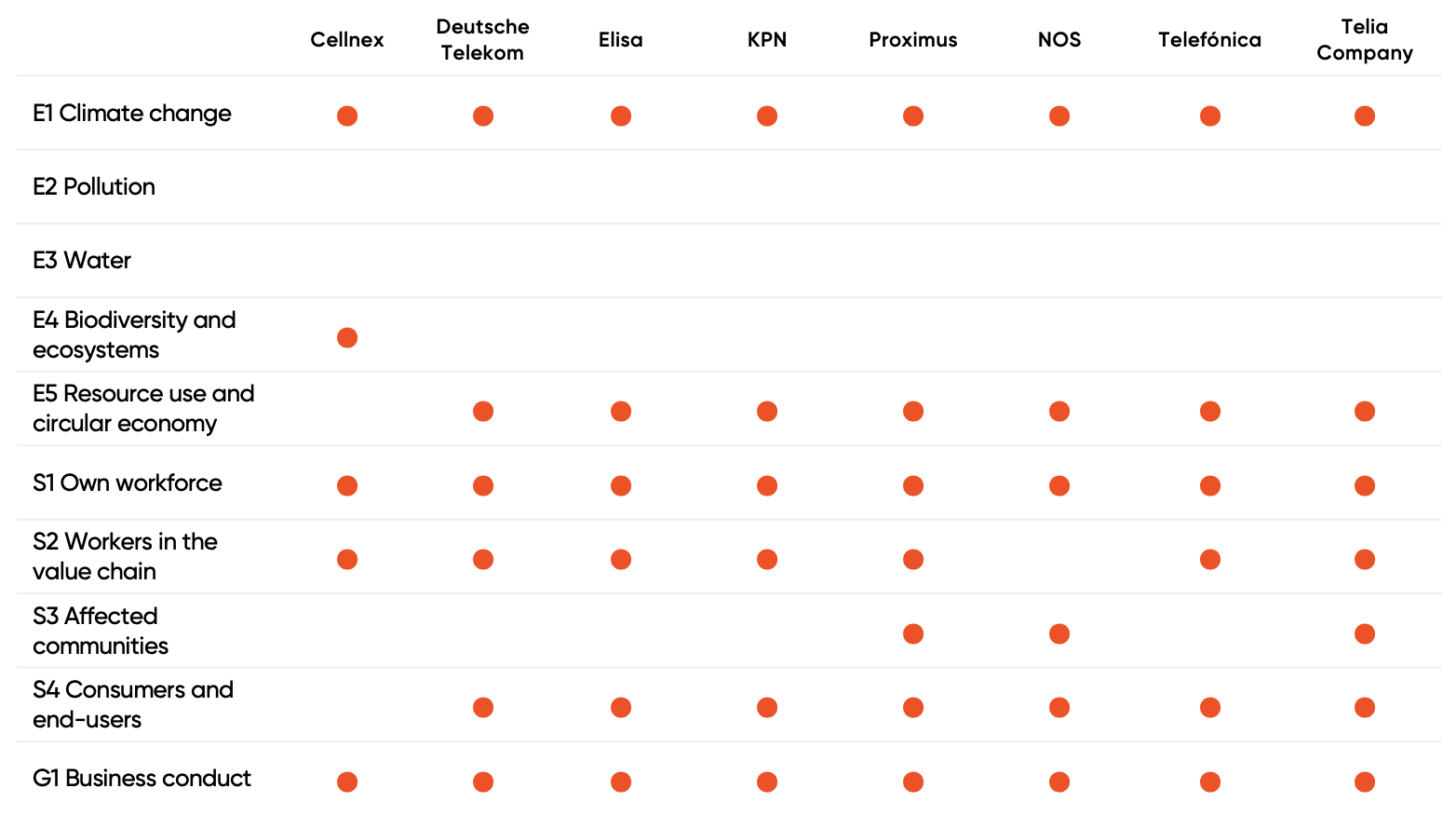
Three out of the ten topics under the European Sustainability Reporting Standards (ESRS) were identified as material by all companies: climate change, own workforce and business conduct.
More emphasis on social topics
Overall, companies identified more social topics, than environmental ones, as material. All companies reported own workforce as a material topic, with the most common IROs relating to DEI, working conditions, and training and skills development.
Companies that identified workers in the value chain as material focused on supply-chain risks such as forced and child labour in electronics manufacturing and mineral sourcing, as well as working conditions, and health and safety concerns due to the nature of the work. Proximus stood out for clearly disclosing the results of its human rights risk assessment, mapping where risks are most significant across different parts of its supply chain. This approach is encouraged as it provides additional transparency.
Another widely reported topic was consumers and end-users. As a strongly consumer-facing sector, companies identified both positive impacts — such as enabling connectivity — and negative impacts, including privacy risks and cybersecurity threats. A few companies, including Deutsche Telekom and Telia Company, also highlighted the impact on children’s rights in relation to this topic.
Only three companies identified affected communities as a material topic. Telia Company and Proximus provided specific IROs covering digital inclusion, freedom of expression and government surveillance, children’s rights, and the physical impacts of installing and upgrading network infrastructure (e.g., nuisances, disturbances, and health and safety concerns related to electromagnetic radiation). NOS also identified this topic as material, primarily due to its positive impact on innovation and digital literacy. However, it did not clearly define the specific impacts, making it difficult for readers to understand what is meant and why the topic is considered material.
Emerging focus on environmental topics
Climate change and circular economy were the most commonly reported environmental topics. This is expected, as telecom’s environmental impacts are closely tied to energy use and material consumption. The sector relies heavily on hardware made from raw materials including rare metals, plastic and glass. The availability of these materials is therefore a key dependency for telecom companies.
At the same time, the sector generates a significant amount of electronic waste. Global e-waste reached 62 million tonnes in 2022, yet only around 22% is formally collected and recycled. This means that valuable materials embedded in telecom devices and network equipment are often lost. The reports of Elisa, Telia Company and Proximus also highlight the need for companies to use resources more efficiently, extend product lifetimes and recover materials at end-of-life to reduce waste and mitigate the risk of future supply shortages. Moving towards a leasing or rental model — could offer a promising opportunity to increase circularity in the sector.
The only company that identified biodiversity as a material topic is Cellnex. Biodiversity is particularly relevant for them because some of their sites are located in or near nature conservation areas, where infrastructure can disturb local ecosystems — for example through habitat disruption of birds. They also acknowledge that land-use changes and the extraction of natural resources used in network equipment can contribute to biodiversity loss. Although biodiversity is largely underrepresented across the sector, Cellnex’s disclosure highlights an important area that other telecom companies may need to consider if it is relevant to their operations and value chain.
Industry outlook
Telecom companies tend to prioritise social topics in their disclosures, reflecting the nature of their business and its direct interaction with customers, workers and communities. While wider environmental impacts are also relevant, most companies place their main emphasis on climate change and circular economy and only one included biodiversity.
Most companies also identify cybersecurity as an entity-specific material topic. Given the volume of customer data they handle and the potential consequences of cyberattacks or data breaches, this area represents a significant responsibility — and a major source of risk — for the sector.
Sources:
Get comfortable, there’s more
If you enjoyed this article, there's plenty more media to get your mind into.


The elements that matter most under the ESRS for chemical companies
Chemicals are essential to modern production but carry a significant global footprint. Our analysis shows that leading companies prioritise climate action, pollution control, health and safety, and responsible chemical management.

Sign up to our newsletter
and we'll report back to you with industry news and updates you'll actually want to know.